Saturday, September 18, 2010

Three Reasons Why Persuasive Design Isn’t Enough to Influence Change :: UXmatters

More Than Words

Three Reasons Why Persuasive Design Isn’t Enough to Influence Change

By Colleen Jones

Published: September 6, 2010

Persuasive design is designing to change people’s behavior, or actions.”

Persuasive design is designing to change people’s behavior, or actions. This design movement fascinates me, and I’m jump-up-and-down thrilled to see it get more attention lately. Forbes recently ran an article about Jon Kolko, creative frontman at Frog Design, and his perspective on persuasive design. Kolko noted:

“Good design is design that changes behavior for the better. I think it needs to take into account the context of the environment, of the human condition, the culture, and then attempt to make the things you do—make us do them better, make us do better things. It encourages us to change the way that we live.”
—Jon Kolko [1]

While there is a lot to like about using design to improve our behavior and our world, achieving that is a tall order. If persuasive design is going to work on a large scale—and I want it to work—it needs to be complete. Here are three reasons why persuasive design is not enough to make all of its good intentions come to life.

1. Persuasive Design Doesn’t Address What We Think

“Persuasive design does not take attitude into account much in its planning, even though attitude is powerful.”

Persuasive design focuses on people’s actions, or behavior, not their attitudes, or what they think. Why? The relationship between action and attitude is hard to measure. Despite that, most people—even academics—assume there is some relationship between what we think and what we do. In fact, there is a long-standing theory in persuasion circles called the theory of reasoned action. The evidence supporting it is considerable. [2] But, it will likely remain a theory, because it is difficult to prove entirely.

To me, the connection between what we think and what we do is like gravity. It is a long-held theory. As a theory, it makes sense and has supporting evidence. However, the exact nature of this complex relationship might be impossible to prove once and for all.   

Here is my challenge. Although gravity is a theory, we still respect it. We plan for it. We don’t jump out of an airplane without a parachute because gravity is only a theory. A parachute like that shown in Figure 1 lets people defy gravity.

Figure 1—Gravity—a theory we respect

A parachute lets us defy gravity

Persuasive design does not take attitude into account much in its planning, even though attitude is powerful. One famous example of attitude affecting action is the scientific taste test between the soft drinks Coke and Pepsi. (I mean the scientific one, not the tests for commercials.) When the taste test was blind, people chose Pepsi. When the taste test was not blind, people chose Coke. In other words, people’s attitude toward Coke was so strong, it drove people to choose Coke over their actual taste preference. [3] Brain scans showed that taste tests in which brands were visible actually triggered different brain activity than the blind taste tests did. That’s potent. Can we really afford to ignore it?

2. Persuasive Design Leaves Out Content

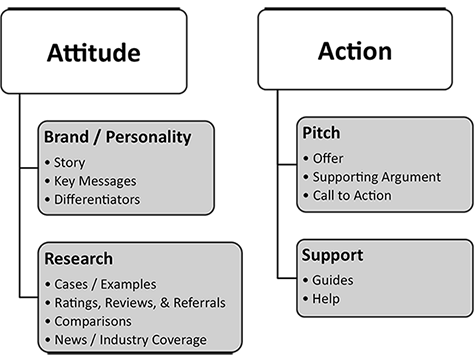
In my experience, content affects both what people think and what they do. Figure 2 shows a few examples.

Figure 2—A sampling of content types that affect attitude and action

Content types affecting attitude and action

When we include content in our planning for persuasive design, we gain greater opportunity to influence. Let’s look at an example from the health industry. CNN recently featured an exciting self-help treatment Kaiser Permanente launched to help people recover from an eating disorder. [4] Central to this treatment is content—a guide on how to overcome binge eating—and occasional coaching. As CNN described:

“When we include content in our planning for persuasive design, we gain greater opportunity to influence.”

“Half the participants were assigned to treatment as usual. They received notifications about available nutritional services, medical treatments, healthy eating, and weight management programs.

“The other half were assigned to a self-guided program for 12 weeks, detailed in a book called Overcoming Binge Eating … and met individually with a health educator for eight sessions. Under the program, binge eaters kept food diaries and wrote what triggered their behaviors.”

Researchers found statistically significant results in favor of the self-help treatment. After a year, 63% of the patients in the self-help treatment had recovered from binge eating—compared to only 28% of the patients in the healthy eating program. The right content and coaching changed these people’s eating behavior. Are we letting content be all it can be in our persuasive designs?

3. Persuasive Design Gets (Mis)Applied As Optimization

“We’re told to optimize our text, buttons, and pictures until conversion rates rise. But, we’ve had years to experiment. If testing and tweaking optimizations worked so well, wouldn’t the global conversion rates have improved by now?”

To this point, I’ve discussed some lofty ideas for improving the effectiveness of persuasive design. Now, let’s look at how people currently apply persuasive design.

To make a sale or get a lead, many Web sites use persuasion like a pushy salesperson, aiming high-pressure ploys at people as if they’re stupid targets. One trick I love to hate is a countdown timer on a sign-up form. Every tick of the timer tries to rush me into signing up. Such tricks act like prods to push people along. But do they get results?

Let’s look at one important type of results—conversion rates. Conversions occur when users take an action you want them to take, such as when they sign up for a service or make a purchase. The Fireclick index

measures global conversion rates. This index has hovered around 2–4%  since 2003. That means, most of the time, people don’t convert. These results are disappointing.

How can we improve our conversation rates? Ever since multivariate testing tools came on the scene—such as Google Website Optimizer in 2006—the industry producing them has encouraged us to rely heavily on testing design optimizations as the answer. We’re told to optimize our text, buttons, and pictures until conversion rates rise. But, we’ve had years to experiment. If testing and tweaking optimizations worked so well, wouldn’t the global conversion rates have improved by now?

Now, allow me to clarify. I’m not saying conversion rates are unimportant. And I’m not telling you to stop optimizing and testing your landing pages. I simply mean that this focus on tactical design isn’t enough to bring big results. I also doubt that focusing only on tactics is what proponents of persuasive design intend. However, if we say persuasive design addresses only behavior, we shouldn’t be surprised to see practitioners focus on optimizing conversions, the most coveted online behaviors.

If we say persuasive design addresses only behavior, we shouldn’t be surprised to see practitioners focus on optimizing conversions, the most coveted online behaviors.

To better persuade, let’s also address what people think, and let's do it with content. What if we created quality, relevant Web site content that attracts people who already have some interest in our products, services, or causes? That would let us avoid manipulation altogether. In fact, Brian Eisenberg, a best-selling author in interactive marketing, has suggested that driving a lot of the wrong people—people who have no interest—to our Web sites is a major reason conversion rates stay so low. [5]

Beyond attracting the right people, I like how content strategist Shelly Bowen explains the possibilities for content in “The Big Picture: End-to-End Content Strategy.” [6]

The sum of the parts is larger than the whole. Just consider content marketing, content strategy, branding … each piece might be brilliant, but still not drive results. A cohesive message and creative across all content delivery vehicles will help raise awareness and need and make you memorable and trustworthy.”—Shelly Bowen

So, What Now?

“To accomplish the good intentions of persuasive design, we need to do more than design to get people to act. We need to create content that influences people’s thinking in a positive way, motivates them to act, and makes acting easier.”

To accomplish the good intentions of persuasive design, we need to do more than design to get people to act. We need to create content that influences people’s thinking in a positive way, motivates them to act, and makes acting easier. As the UX design industry pays more attention to content, we’ll be better prepared to influence what people do and think—and have a real chance at making the world a better place, online and off.

References

[1] Laneri, Raquel. “Jon Kolko on Design That Changes Human Behavior.”

Forbes, June 15, 2010. Retrieved July 1, 2010.

[2] Hale, Jerold L., et al. “The Theory of Reasoned Action.” The Persuasion Handbook: Developments in Theory and Practice. James Price Dillard and Michael Pfau, eds. Thousand Oaks, CA: Sage Publications, 2002.

[3] McClure, Samuel, et al. “Neural Correlates of Behavioral Preference for Culturally Familiar Drinks.” Neuron, Volume 44, Number 2, October 14, 2004.

[4] Park Madison. “Self-Help Treatment Effective for Binge Eating, Researchers Say.”

CNN, April 1, 2010. Retrieved July 5, 2010.

[5] Eisenberg, Bryan. “The Average Conversion Rate: Is It a Myth?

ClickZ, February 1, 2008. Retrieved August 20, 2010.

[6] Bowen, Shelly. “The Big Picture:End-to-End Content Strategy.”

Pybop, October 21, 2009. Retrieved July 24, 2010.

Topic: Columns | Content Strategy | UX Design

Comments (3)

JkolkoAuthor Profile Page

wrote:

-->

Colleen,

Thanks for writing a thoughtful piece that extends the dialogue related to interaction design—the design of behavior, with the intent to drive change.

I don’t agree with two of your three points.

First, you said that “Persuasive design focuses on people’s actions, or behavior, not their attitudes, or what they think.” Noting that you are using persuasive design and interaction design interchangeably, I beg to differ. From an academic perspective, you might consider the four orders of design, offered by Richard Buchanan, that drives from signs, to things, to actions, and to thought. The last order describes system thinking, related to organizational change, and empowered by strategy and discourse. From a pragmatic perspective, I would consider a directive toward attitudes fair game in contexts of branding, policy making, advertising…. Any design researcher I know attempts to understand aspirations in order to drive design change.

Next, you said that “Persuasive Design Leaves Out Content.” That’s simply not true, as interaction design is fundamentally about value structures, where generic placeholder content simply doesn’t work. Design is all about details, and those details are commonly in context and content. I’ll give you an example: Project M included the development of prototypical HIV testing material. The content for this material is the instructions, and the form factor, and the illustrations, and the other various design elements—color, composition, and type. And the content was defined in excruciating detail. It had to be; content and context largely speak to value systems, which drive interaction design work.

I completely agree with your final point, that “Persuasive Design Gets (Mis)Applied As Optimization.” We can do a better job of articulating and constantly reminding our colleagues of the value of interaction design on an emotional and fundamental level rather than on a process optimization or usability level.

Thanks,

Jon

Posted on September 6, 2010 7:40 AM

TommyloutsAuthor Profile Page

wrote:

-->

Got it. Like it. Thanks.

Note that persuasive design is just plain hard. It is hard to get a grip on context factors, attitude, and appropiate content. Just as it was hard to defy gravity back in the day. (Note here that only a guy named Leonardo Da Vinci could come up with this kind of stuff.)

Posted on September 7, 2010 12:16 AM

Jones LeenAuthor Profile Page

wrote:

-->

Hi Jon,

First off, thanks for taking the time out of your busy schedule for offering such thoughtful comments. I appreciate it, and I’m sure the readers of UXmatters do, too.

We might have to agree to disagree on points 1 and 2. But, I think point 3 is related to, if not somewhat caused by points 1 and 2. So, if you agree with 3, maybe you’ll concede a bit about the other points. At the least, you can’t blame a girl for trying.

Regarding reason 1, I tried not to get too academic. But, if we need to get academic, the article “Interactive Technology and Persuasion” in The Persuasion Handbook explicitly recommends focusing on behavior over attitude. Much of the work content does is influence attitude. When persuasive design focuses on behavior, it excludes much of the work related to attitude and, consequently, much content work.

About using persuasive design and interaction design interchangeably, I see persuasive design as the whole kit-and-kaboodle, from surface graphic design to deeper interaction and system design. I like the idea of including organization design, too. I find that runs in parallel with content being everything from the surface copy to the deeper structure, system strategy, and organizational process to create and manage content.

Regarding reason 2, I see two ways that persuasive design leaves out content: how it’s discussed and how it’s applied. From the example you described and everything I’ve heard, Frog Design doesn’t leave content out of its application. That’s awesome. However, I still don’t see or hear much about content when persuasive design is discussed. (In fact, your comments might be one of the first times I’ve seen such a discussion. I look forward to more.) I suspect that, if I did a text analysis of how many times the term content is mentioned in persuasive design articles and books, I’d come up with a low number. Maybe even a big, fat zero. I’m concerned about content being excluded—intentionally or not—from the discussion for three reasons: 8d22ab7a50d2d19432d6e3897cd3689a

Even though we might have to agree to disagree, I see having this discussion as huge progress. Thanks again.

Hi Tommy,

Many thanks. I couldn’t agree more that persuasive design is just plain hard. But, I think it’s worth the effort.

Colleen

Posted on September 8, 2010 6:16 PM

Join the Discussion

To make comments, you must first sign in using your Facebook, Twitter, OpenID, or another user ID.  |   Sign In


Interesting counter argument to using Persuasive Design. I'm reading several books on persuasion and one in sales specifically focuses on the type of personality and the types of decisions they might make. I think that is part of the nut that this article is hitting on.

Posted via email from John Whalen's Posterous

8 Must-see UX Diagrams | UX Booth

All the classic UX diagrams in one post. Nice.

Posted via email from John Whalen's Posterous

Friday, August 27, 2010

Apple Doesn't Target Markets. It Targets People

It targets people. It focuses on users. And Apple lets them decide how and where they’ll use its products.

This sounds simple, but in my experience very few companies think this way. Most startups write business plans that dredge up IDC data on market size, then define their target market (e.g., “Global 2000 enterprises”). Few seem to realize that there are people employed within these target markets, and these people will be the ones who actually embrace or reject one’s product.

Indeed, I’d go so far as to suggest that this is one of the primary failings of most enterprise software today: It’s built for enterprises, not for people employed by the enterprises, a theme echoed by noted developer Michael Nygard.

Not all companies screw this up. The open-source world offers a few good examples of companies that understood their target market was the individual, not the tribe/company.

Marc Fleury’s JBoss, for example, understood its target market was the developer buried within corporate IT. All JBoss’ early marketing was focused on developers, not CIOs, and its product development was focused on making developers happy. Only later did those developers return the favor by pushing JBoss into serious production, requiring the CIOs to get involved.

Along the way, JBoss took its share of criticism for this indifference to decorum and CIO concerns, including accusations that the company “astroturfed” to drum up developer support. True or not, the accusations don’t diminish JBoss’ clear success winning over developers by catering to developers.

The same is true of SpringSource, which fought off the accusation that it wasn’t “enterprise ready” by being “developer ready” from the start, and focusing relentlessly on pleasing its target market: the developer.

This is how great companies are built: they focus on individuals and build exceptional products for them, and let these individuals determine how best to make use of the technology.

Nice summary of the value of people-centered design.

Posted via email from John Whalen's Posterous

Half Of All Facebook Users Play Social Games — It’s 40% Of Total Usage Time

But the most interesting thing Pleasants noted was that he recently heard (from his own source, apparently) that half of all users on Facebook now play social games. More impressively, 40% of total usage time on the service is spent on these games. That’s meaningful, of course, because “a huge amount the Internet is on Facebook,” Pleasants stated.

When moderator Michael Arrington asked about changes Facebook has made recently to slow the viral spread of these types of games, Pleasants acknowledged they’ve all taken a hit. But he says they’re working with Facbeook on new ways to drive growth. But he made sure to say they had to do it without spamming.

When talking about what’s next, Pleasants notes that they’ve released two new games in the past week alone. When Mike suggested that most of the games are just a combination of blindly pushing buttons, Pleasants noted that things were evolving, and that games were about to get more social.

Interesting to see where social games are going. Note that 40% are doing games, but still sharing photos and ideas socially remains the biggest piece of activity on Facebook.

Posted via email from John Whalen's Posterous

Wednesday, May 26, 2010

How to be a Gov 2.0 Ninja @lostonroute66 #g2e #gov20 #ux #ixd #ogov

  • Focus on Pillbox
  • Has API - drive traffic to it
  • Pillbox by phone - queries pillbox by speaking - created by student at GWU - created it in 3 weeks
  • There's an IM version of it tool
  • iPhone Pill Discovery App - someone scraped our data and made the app
  • PharmvilleRx - prescribe meds, does teach about meds, even if irreverent
  • Sharing Facebook interface FBML <> PHP
  • Have released a lot of code re this.
  • Creating new way to open data and solve challenges - lots of orgs want to work with them ... and still in beta
  • Found ancient text on being Open Gov Ninja???  Mid 12C Japan? Open Gov Initiative?
  • What is Open gov Ninja
  • Ninja Myth: if they could be effective - they'll do it.  
  • Centers on Data.gov agency.  From 26 to >200K datasets
  • skills: Innovation - do something new and unique
  • Ninja Myth: Ninja used magic - nope used what was available to them (e.g., farm tools)
  • Andrew.wilson@hhs.gov - web new media strategist SAHMSA - using google docs and google pipes
  • had to bridge Open & transparent to Usable
  • Took 9 people and several parts of 2 agencies FDA, NLM, 3 months for standard.
  • Ninjas did learn from secret texts, but also from leaders...like Hopra and Kundra
  • We have texts - WebContent.gov...
  • but no mountain hideaways...do have Gov20 and Health20 web meetups
  • @levyj412 : mission, tool, metrics, teach
  • Now outside: Strategy, Ethnography
  • learn from our citizens - Michael Wesch, KSU; Gelly Goto
  • field studies, ethnography, shadowing
  • Listened to people about how they worked and lived
  • Strategy: Ethnography; Activity: Personas - for debate - answer using personas or get back out with your citizens
  • This is user centered design - citizens should outnumber you
  • Strategy: Community Engagement
  • Health Information Unconference
  • Even if usable, need support of community - need champions - engaged communities
  • Ask community - took pillbox on the road
  • HealthCamp provided advice and grew community.  Felt ownership of project.
  • Read comments in blogposts
  • picked up by lifehacker, and got 
  • Activity: Building Open Data
  • Ninja Myth: Ninjas created by Linux
  • Stallman: GNU Project "Free as in Speech" not "Free as in beer"
  • listen to your citizens take the wheel - they know where they are going
  • pillbox API data as a web service - they knew they were helping to prove this
  • API for medical journals
  • Trying to see if we can have API Catalog
  • Strategy: Must take data to your users
  • we have data and an API that can solve problems
  • kicked off program on farmville, in hackathon.
  • wrote wrapper in Ruby to GitHub; another person wrote in Python
  • Did better with coopetition.  Only possible with open system
  • Ninja Stealth: Not really useful or practical
  • Is your project aligned with your organization?
  • Think small, small and iterative, fail fast, document failures "look what we've learned from this"
  • Have cover - member of management who like the project
  • Management buy-in show buy in and success from other agencies.

Posted via email from John Whalen's Posterous

Democratizing Content: Gary Vaynerchuk @garyvee #g2e #gov20 #crushit

  • Built $60M job w/ Web 1.0 strategy
  • How I built brand, and amazing opportunity
  • America is the brand that sold my parents
  • Not techie, not interested in platform.  Like message.
  • Disrupted my marketplace in 24 months
  • We have been in push business for last 70 years
  • Now in pull business
  • Writing new book on ROI of new media.
  • Interesting idea: Raise your hand: "How many of you said you'd never get a cell phone?  How many still don't have one?" - message: We change our opinion do be ready for change.

Posted via email from John Whalen's Posterous

Creating Passionite Citizens: Kathy Sierra #g2e #gov20 #ux #ixd

  • Gov Social Media fantasy: Open Data; ????; Passion!   < really???
  • No, so we need to see what people are really interested in and passionate about
  • You hear more the more you've learned about music, or see more if stargazer 
  • High resolution means deeper dive.  Must find a way to enable "kicking ass & higher res"
  • Don't make a better (x); make a better (user of x)
  • Make a killer user, not killer app
  • Picture the badge on their superman suit 
  • Hard to get that passion - except for pets - need to hook into that - gateway drug for passion
  • Need Trojan horse to create passion
  • 1. Teach something cool: How to make an apple switcher video which is actually for the Dean switch campaign, Netflix Oragami - get something they can do
  • 2. Ask someone to do something: Request your thing in the wild - picture of book with running with the bulls. 
  • 3. Wrap it in compelling context: Made calendar for water quality report and tips.  Filled with water quality tips.  Looked like pin up calendar, or copies of movie covers.  Can buy the LOLcat bible.

Posted via email from John Whalen's Posterous

Berners-Lee: Open, Linked Data for a Global Community #g2e #gov20 #semanticweb

Tim Berners-Lee
  • Four levels: Putting info up, making it accessible, give it location and linking it.
  • Name: not crisps - called potato ships - local name
  • Working on potato chips labeling...nutrition facts, serving size, calories - that's what people look for in US
  • Bar code - language understood globally by machines
  • Need common schema and link the different sets of terms (crisp/chips,etc.)
  • Can use other people's vocabulary - small number of people can work out links.
  • [sorry hard to hear him...missing lots]

Posted via email from John Whalen's Posterous

The Pillars of Gov 2.0 #g2e #gov20 #cloud #australia

Senator Kate Lundy @katelundy
  • Australian government - seeing a lot in UK, US, and Canada
  • Pillars: Democratizing data, make information publicly available in useful open format.  Attitude and practice needed. (GovHack)
  • Citizen-Centric Services: always up-to-date.  Not obscured by org-chart of gov.  Give personal detail based on personal info they are willing to provide.
  • Participatory Government: always been there with voting.  Making collaboration in developing laws.  Crowdsorcing at its most constructive.  
  • Each of these can improve trust.  Australia has made remarkable progress in this regard.  Requires leadership and shared goal.
  • Universal national broadband network.  Computer in every secondary student.  Unrivaled.  Know they can invest in Gov2.0
  • New Freedom of Info act, and Information Commissioner designate - already appointed.  Guides disclosure, management, and usability of data from gov.
  • There is Gov2.0 blueprint doc.  Gov 2.0 Taskforce
  • New Gov2.0 showcase of initiatives.
  • Must transform or become irrelevant.  Focus on Democratizing data, citizen-centric services, and participatory Government.

Posted via email from John Whalen's Posterous

Unlocking Real-Time Data #g2e #gov20 #cloud

Joshua Rubin, Unlocking Real-Time Data
  • Unlocking real-time - why hard?
  • National weather service is open...so consumers have lots of choices
  • Opened up MBTA (Boston) data, several apps built quickly for schedule
  • Traditional model: countdown system, then shared.  What if we shared first bus location system first.
  • Provided real-time data feed.  W/in 1 hour someon had it on google maps, 1 week desktop widget, w/in 5 weeks nice iphone app, 8 weeks then text msg system.  No cost to MBTA.
  • Beginning to open system for rest of busses.
  • Imaging the innovative solutions.
  • someone built bluetooth watch w/ realtime data.
  • Therefore...Release your data first and let others create solution.

Posted via email from John Whalen's Posterous

Cloud Computing Services: O'Reilly chat w/ Google and City of LA. #g2e #cloud #gov2

Randy Levin (City of LA), Dave Girourd (Google), O'Reilly

  • Going to cloud, saving $500M
  • Novell currently for email.
  • End of RFP process what would need is going to google and leapfrog
  • Google - biggest cloud objectives
  • who owns data
  • how is it managed
  • data distributed over massive computing infrastructure
  • Google: not trying to lock people in
  • O'R: do you feel locked in?  
  • L: No more than SAP.  More free that way.
  • O'R: What are some of the new parts of the Google toolset?  e.g., Automatic translation (that have no obvious financial need)
  • G: When Google got into multilingual and taken things that are fanciful science project that are approachable (e.g., google earth).  Thinking about speech recognition, translation - really only work on massive scale.  Devices too: Chrome OS and Android will adapt to data stored in cloud and these things access the data.  
  • O'R: Polyglot LA...issue of languages increasingly difficult to give services to all citizens.
  • L: Need to figure out how to embrace this.  Really we're only on email and calendaring.  Current email wouldn't work w/ Android, iPhone.  Don't want to worry about having standard device.  Can let workforce use whatever they like.
  • O'R: One piece of advice to agency looking to cloud compute
  • L: Know your requirements.  We thought we did, but didn't.  Elongated process.
  • G: Large org need to think of it as transformational change.  Means to end.  Signify that change is afoot.  Need high-level push that times are changing and cloud is one way to do that.
  • Posted via email from John Whalen's Posterous

    New Opportunities and Responsibilities in Cloud. Microsoft #g2e #gov20 #cloud

    Brad Smith, SVP Microsoft
    • World racing to the cloud
    • New power for info - 311 - e.g., getting pothole fixed.  Can report and see progress
    • Took them 8 days from conception to deployment.  From platform people know and understand.
    • NASA - JPL - Arizona state + Windows Azure - can look at Mars pictures and link to geolocation
    • Challenges:
    • Issues of privacy - cloud at Microsoft or Google.  Privacy reshaped.  Security too.  
    • Data center can provide more data security.  But attract people who want to get in when you set up Fort Knox
    • Challenges for national sovereignty - Italian using Irish cloud run by US company going through France.  No answers for this yet.
    • New Responsibilities:
    • Innovation - keep innovating to keep protecting privacy (e.g., in private on IE 8)
    • New Leadership in Gov: Laws need to be modernized.  Protection of privacy - 84 and 86 for Privacy and electronic security.  Need updating
    • New Collaboration - need govs to work together to make progress and address challenges need...
    • New Conversation:
    • Recognize the way it can benefit government, citizens, citizen groups.

    Posted via email from John Whalen's Posterous

    Cloud Computing Services: O'Reilly chat w/ Google and City of LA. #g2e #cloud #gov20

    Randy Levin (City of LA), Dave Girourd (Google), O'Reilly

    • Going to cloud, saving $500M
    • Novell currently for email.
    • End of RFP process what would need is going to google and leapfrog
    • Google - biggest cloud objectives
      • who owns data
      • how is it managed
      • data distributed over massive computing infrastructure
    • Google: not trying to lock people in
    • O'R: do you feel locked in?  
    • L: No more than SAP.  More free that way.
    • O'R: What are some of the new parts of the Google toolset?  e.g., Automatic translation (that have no obvious financial need)
    • G: When Google got into multilingual and taken things that are fanciful science project that are approachable (e.g., google earth).  Thinking about speech recognition, translation - really only work on massive scale.  Devices too: Chrome OS and Android will adapt to data stored in cloud and these things access the data.  
    • O'R: Polyglot LA...issue of languages increasingly difficult to give services to all citizens.
    • L: Need to figure out how to embrace this.  Really we're only on email and calendaring.  Current email wouldn't work w/ Android, iPhone.  Don't want to worry about having standard device.  Can let workforce use whatever they like.
    • O'R: One piece of advice to agency looking to cloud compute
    • L: Know your requirements.  We thought we did, but didn't.  Elongated process.
    • G: Large org need to think of it as transformational change.  Means to end.  Signify that change is afoot.  Need high-level push that times are changing and cloud is one way to do that.

    -

    Posted via email from John Whalen's Posterous

    Tuesday, May 25, 2010

    yolink - Interesting new search tool #ixd #ux

    This one actually dives to a specific paragraph within a document, not just the document itself. Novel search strategy.

    Posted via web from John Whalen's Posterous

    Wednesday, April 28, 2010

    Playful Design: Why foursquare gives you badges...

    In foursquare the game adds interest single-user experience, because when you check into places you can start earning badges and mayorships right away. For first time-users, that's very important. It changed
    the reason to check in. Then people ultimately discover the core application as they start to find their friends, restaurant reviews, and so forth. By that point, the game mechanic is intended to be secondary to that experience.

    Interesting idea about transition in #UX for #foursquare #gamedesign

    Posted via web from John Whalen's Posterous

    Can markets be rational when humans aren't? | Behavioral Economics #persuasivedesign

    Mind Over Money

    Can markets be rational when humans aren't?

    http://video.pbs.org/video/1479100777/#

    Why is our economic model that we mostly respond "as if" we're rational...

    Posted via web from John Whalen's Posterous

    Brains, Behavior & Design

    We have created five tools to help designers apply findings from the field of behavioral economics to their practice in order to provide a head start on framing research as well as developing new strategies for solving user problems. Download the introduction book.

    This tool kit includes:

    This team at IIT have made a really impressive little kit focusing on behavior and how design can influence it. Well done! Check it out.

    Posted via web from John Whalen's Posterous

    Sunday, April 25, 2010

    The essence of an elevator pitch: Tell me why I should join you, invest in you, and buy from you. 100 words.

    “Tell me more.”

    Lessons Learned

    • Complex products need a simple summary
    • Tell me why I should quit my job to join you
    • Tell me why I should invest in you rather than the line outside my door
    • Tell me why I should buy from you rather than the existing suppliers
    • Do it in 100 words or less.

    Interesting note on how startups should produce an elevator pitch, but it strikes me as relevant to anything we do...

    Posted via web from John Whalen's Posterous

    Friday, April 23, 2010

    8 Significant Developments in Social Media You Should Watch

    1. MySpace: CEO Leaves; MySpace will die. But now I wonder: Who is going to be the next MySpace? Virb? Bebo? (And don’t underestimate LinkedIn.)
    2. Virtual Goods: Insane, but insanely popular. The creation and selling of virtual goods and gifts makes absolutely no sense to people who just use the Internet as a basic communications tool. Have you even thought about how you might be able to leverage virtual goods? Related GigaOM Pro content (sub. req.): How the Next Zynga Could Reinvent Social Gaming
    3. Gaming: Not just for kids anymore. According to Nielsen Entertainment in August 2009, of the 117 million active gamers in the U.S., 56 percent play games online and 64 percent of those online gamers are female.Have you used gaming yet in a social media marketing campaign?
    4. Twitter: Still transforming communications. Back in 2008, How has Twitter helped you lately?
    5. Niche networks: A marketer’s secret weapon. Whether you choose Ning.com or KickApps or any of the other “white label” customizable social network-building platforms, the concept of creating a “gated”online community that is narrow in focus is smart and potentially powerful. What niche networks are you participating in or do you run?
    6. Augmented reality. Sounds sci-fi, but it’s really here. I’m having a hard time describing Augmented Reality to people who haven’t seen it (if you haven’t seen it in action, these infographics from GigaOM might help). AR uses simply boggle the mind, and I plan to explore more of that in this column soon. I do wish we had a better term for it, though (like “data overlay” or “overscreen view”) so it didn’t have such a sci-fi feel to it. What potential uses for AR are getting you fired up? Related GigaOM Pro content (sub. req.): Augmented Reality: Lots of Promise, Lots of Hurdles.
    7. Google Buzz: Pay attention, even if you don’t care. I am one of the gazillion people who currently do not care about Google Buzz, apart from the fact that just because Google did this it means something in terms of the tools we’ll be using in the coming years.
    8. Mobile: Be there. I don’t know about you, but I consider my iPhone to be a mini computer and Wi-Fi device first and phone a distant second. I’m never normally an early early adopter because I’m too busy to keep up most of the time, but I will be one of the first to buy the iPad, because it looks to me like a bigger iPhone, and I rely on my iPhone in ways I have never relied on my computer or my regular cell phone.

    Interesting summary - I'd say its pretty much right on.

    Posted via web from John Whalen's Posterous

    Design for Persuasion

    1. Deconstruct the copy for “persuasion factors.”.
    The ability to persuade is built on ease of comprehension leading to interaction with your message. In other words, once the reader is hooked, going on to absorb the rest of the design says the reader has agreed to be persuaded. Your job is to make the persuasive argument immediately understandable.

    To persuade, you must capture readers’ attention until they convince themselves. Deconstructing the copy for persuasion means deciding how to emphasize the selling words and action words by size, color, repetition, and the use of imagery to summarize the value and emotional appeal of the copywriter’s intent.

    Alice Williams Taus, longtime creative director at Rodale Publications and now a freelance designer, says, “Repetition is important in persuasion. Clever design allows the message to be repeated in different ways, until it becomes almost subliminal and imprints on the mind. Think about where the person starts and stops, where the hand will touch the material and how the hands frame the message, and then what you want the person to feel and do—turn the page, tear out the coupon, fill out the order form.”

    And by the way, putting quote marks, for any reason, in a headline or subhead increases readership.

    2. Find the emotion that sells; or, how to avoid puppies, kittens, babies, and babes.
    In all effective creative work that’s designed to persuade, emotion is employed and is appealed to either subliminally or blatantly. Identify the emotions that do two things:

    • Get attention for the ad, mailing, or website
    • Keep driving the message home

    Then select the images, the colors, and the type that immediately convey the emotional appeals.

    Next, identify the benefit messages, and lead the eye to the benefit that links to the emotion. The design formula = Emotion to Benefit to Response. And, actually, it is OK to use puppies, kittens, babies, and babes if all else fails.

    3. Create “moments of decision” visually.
    To start, describe to yourself in detail the act of responding. What makes the reader want to respond? How will he feel as he decides? What is the actual response mechanism? Does the reader pick up the phone? Go to the website? Send back a form?

    Find the copy that describes the act of response and visually emphasize it. Make it stand out with symbols of value and text that emotionally sell.

    Text that directs the reader to respond and information on how to respond need to be featured in places where the hand and the eye come to rest. Sometimes those spots will be natural or instinctive, like the bottom-right corner of a page. But just as often your design will direct the viewer’s eye.

    Add visual elements that literally point where to respond, leading from page to page or element to element. Arrows, rules, swaths of color are all visual forms that support the response impulse.

    Counterintuitive tricks like including a sticker that gets moved to a response card help lead the hand to the spot that triggers response in the layout.

    4. Practice weird science (designus interruptus).
    Design elements that cause the reader to go “huh?” momentarily can subconsciously refresh attention and arouse curiosity. These should be subtle—not like suddenly leading an elephant into the room. Doing something slightly visually uncomfortable— like covering part of a face, printing a faux sticky note over a face, or putting a headline across the fold in a brochure—can be a powerful device to keep readers attentive without stopping the flow.

    5. Use the science.
    In designing for persuasion, don’t let the desire to be original persuade you to forgo techniques proven to be effective. Adding these techniques to your repertoire can activate your talent in new ways, and allow you to create design that powerfully persuades.

    This is getting interesting: Totally different advice on how to be "Persuasive"

    Posted via web from John Whalen's Posterous

    Thursday, April 22, 2010

    Persuasive Web: Where Psychology Meets Conversion

    VI. Reciprocity: We feel obligated to return favours performed for us.

    Reciprocity16. Give to Get: Give your customer something before you ask them to give you anything.
    Example: Free software download, followed by an email request to rate your software 5 stars, if they like it.

    17. Ask for Favours: Without giving anything, ask users to do a favour for you, with the favour element clearly highlighted.
    Example: “Can you please help us? We’re trying to get the word out about our blog – so would you do us a favour and Digg it if you like it? Thanks so much.”

    VII. Scarcity: The less available something is, the more we want it.

    Scarcity18. Sales – Urgency: Highlight the end date or time for a sale.
    Example: “Sale ends midnight (MST).”

    19. Sales – Flash: Intentionally limit sales to a very short period of time – and explicitly state the time.
    Example: Clear start time for sale, and countdown of hours left in your sale.

    20. Just 1 Left! Provide a real-time countdown of the quantity of a high-value item available.
    Example: Number of seats remaining for a concert or on a flight.

    21. Exclusive Access: Provide access to an event on your site to a limited number of people only (and commit to that number) to encourage those with access to take advantage of this exclusive opportunity.
    Example: Invite a select group of preferred customers to your site for a sale, and give them a personalized access code as well as start/end times.

    VIII. Social Proof: We look to what others do to guide our own decisions and behavior.

    Social Pressure22. Herd Behavior: Showcase ratings & reviews from users alongside offerings to help narrow decisions for shoppers.
    Example: “Rated 4.38 out of 5 stars by Canadian entrepreneurs.”

    23. Social Pressure: Quantify the number of others who are already doing what you want your new users to do.
    Example: “Already 80,000 users worldwide in just 6 months.”

    24. Intelligent Recommenders: Use data from other shoppers and/or the current shopper (e.g., past behaviours) to recommend new best-match products and effectively narrow choices into sets.
    Example:
    “People who bought the Apple iPhone also looked at the Palm Pre.”

    IX. Trust: Show your character and competence to help people feel confident in choosing to work with you.

    paypal_logo25. Low-Risk Purchase – Return It: Build trust and reduce barriers for shoppers by explicitly stating your return policy.
    Example: “No hassle returns! We even pay the return shipping.”

    26. Clear Payment Options: If you allow users to pay by PayPal, credit card, e-check and/or other methods, or if you have credit terms, highlight those options early in the process (pre-cart).
    Example: “Don’t pay for 90 days – or pay easily today by PayPal, Visa or MasterCard.”

    27. Interface Properties – Brand: Clearly brand your site to ensure users know they’re on a legitimate site for purchasing and feel confident providing their credit card info.
    Example: Consistent brand elements throughout the experience.

    X. Other: Extra persuasion tips/tactics that are so unique, they just can’t be categorized.

    repetition_warhol228. Repetition: Say it once. And remind them of it again to reinforce facts and reduce barriers related to uncertainty. (You don’t want users to have to hit the Back button to find that info… and end up abandoning their carts.)
    Example: “We accept PayPal” messaging near purchase calls-to-action and again at entrance to cart.

    29. Because: The word “because” is a cue to people that they are in the presence of reason and logic and that, in turn, they don’t need to think – the thinking’s already done for them.
    Example: “More people choose our product because it’s the only one that removes stains in 4 minutes flat.”

    15. Security: Highlight security & safeguards on your site to help users trust that you’ll protect their info.
    Example: HackerSafe logo placed prominently on main pages and nearby buttons in cart.

    Interesting persuasive article: Part 2

    Posted via web from John Whalen's Posterous

    Persuasive Web: Where Psychology Meets Conversion

    here are 5 principles of persuasion and 15 ways for you to apply them to your own site:

    I. Authority: We look to experts to show us the way.

    time magazine1. Endorsements – Publications: Showcase endorsements from trusted publications to build credibility.
    Example: Product review quote and logo from significant published authority (e.g., Time Magazine).

    2. Endorsements – Experts: Showcase endorsements from trusted experts in a field to build credibility.
    Example: Video testimonial from a well-known user (e.g., Seth Godin).

    3. Endorsements – Influencers: Showcase endorsements from trusted influencers to build credibility.
    Example: Preferred product selection or recommendation from authority figure (e.g., Rachel Zoe for PiperLime).

    II. Commitment & Consistency: We want to act consistently with our commitments and values.

    tell-a-friend4. Say-Do: You say you’re going to do something, and you do it.
    Example: Specific call-to-action buttons that match exactly what you want the user to do (e.g., “Order the Swiffer Sweeper Now”).

    5. Make “Free” Great: Give away items that are as high-quality as your paid items.
    Example: Free webinars packed with useful content – not fluff.

    6. Share with Friends: Visitors who would recommend a product to a friend are more likely to purchase that product.
    Example: “Tell a friend” calls to action.

    III. Contrast: We notice and decide by the differences between two things, not absolute measures.

    comparisonchart7. Bang > Buck: Simplify product selection by telling users which product/service will give them the most for the least.
    Example: A “best value” icon positioned on/near the product.

    8. Line ‘Em Up: Position similar information across various products in a standard layout to help users easily scan and contrast features, pricing, etc. and, in turn, narrow their options.
    Example: Price for products positioned in same proximity to each product and formatted identically.

    9. Proximity in Lists: The items you place at the top of the list are the items that will create context for shopping (on your catalog page in particular).
    Example: List the items your want users to choose from at the top of a list, with lesser items lower in the list.

    IV. Engagement & Emotion: We want to interact with things that make us feel.

    FamCarnival1510. Play: Make your site or the tasks on it feel more like a game to activate an emotional response in users and limit the amount of executive thinking (the bane of persuasion efforts) required.
    Example: Car-builder tools on auto sites.

    11. Interaction: Use interactive tools to help people find the information they’re looking for (rather than sorting through lines of text).
    Example: Product recommendation quizzes.

    12. Affect Recruitment Heuristic: Use images & messages that help your users picture themselves doing something with a purchased item, feeling a certain way (i.e., experiencing affect) about that image, and using that feeling to make a purchasing decision.
    Example: Imagery of a melting slushy drink on a cabana (on a travel site).

    V. Likeability: The more we like people (and companies), the more we want to say yes to them.

    shaving-man13. Be Transparent. No, Really.: Be completely honest about your company’s motivations.
    Example: Tell users that you’re giving them your product for free in the hopes that they’ll love it, share it and be willing to pay for it later.

    14. Cause Marketing: Support a relevant-to-your-brand cause to help users relate better to your brand.
    Example: Tide’s Loads of Hope campaign.

    15. Win Healthy Debates: Encourage users to find flaws in your product – flaws you know you do not have. In seeking out a flaw but not finding it, users will be more likely to believe in you than had they been indifferent to flaws.
    Example: Money-back guarantee if your product doesn’t save users at least 5 hours each month.

    Interesting persuasive article: Part 1

    Posted via web from John Whalen's Posterous

    Wednesday, April 21, 2010

    Persuasive Architecture and AIDAS - Conversion Chronicles

    AIDA stands for awareness, interest, desire, and action (we add satisfaction). It's "one of the oldest and most durable" cognitive models (describing buying and selling process maps) because it helps marketers appeal to consumers' emotional and social needs.

    Persuasive systems are complex. Their success depends on their ability to address the varying levels of need a user brings to the online experience. To be effective, a Web site must address these user needs at every point in the process. AIDAS provides the lubrication for users to proceed along their given path through a series of microactions.

    Most people measure conversion by the complete macroaction (the ultimate objective) they want users to take (e.g., how many people bought, subscribed, registered, etc.). Each of these actions comprises a series of smaller actions. Each microaction or omission of one is a step closer or further away from your ultimate objective. The devil is in the details. Microactions are the measures of "almost success." In a persuasively designed site, the reject rate of a page that qualifies interest is a clear signal of what needs to be adjusted.

    It's during the wireframe and storyboard phase we ask three critical questions of every page a visitor will see:

    1. What action needs to be taken?

    2. Who needs to take that action?

    3. How do we persuade that person to take the action we desire?

    Here's a different take Bryan Eisenberg takes. Hmmm. Not seeing the common vision between the articles I've shared.

    Posted via web from John Whalen's Posterous

    Tuesday, April 20, 2010

    Seductive Design for Web Sites

    There’s a Seducible Moment

    Education has a concept called "the teachable moment," the point when a learner is ready to learn, willing to change, and can act. For web sites, the parallel is something we call "the seducible moment." This is the point at which designers can entice users off the path to their original goal with the lure of something else.

    The seducible moment can happen only when users have completed at least part of their original quest. It’s difficult to lure users away until they’ve reached this (self-defined) point; before that, they will simply ignore distractions. We’ve seen this frequently in our web-site usability testing.

    Given this finding, the concept of the seducible moment argues against placing web ads in their traditional place at the top of a page. Users seem more willing to be seduced if an ad appears after they’ve found the information they’re most interested in.

    Interesting note on placement of adds and seducible moments

    Posted via web from John Whalen's Posterous

    Joshua Porter | dConstruct 2008

    Leveraging Cognitive Bias in Social Design

    Another interesting dConstruct talk.

    Posted via web from John Whalen's Posterous

    How Gaming Makes the World a Better Place | dConstruct 2008

    Playing the Web: how gaming makes the internet (and the world) a better place

    Opera Software

    Transcription sponsored by Opera.

    Hello! Yes, my name is Alex Krotoski. I’m slightly nervous, I have to admit. I’m either going to stay here or I’m going to run around. So, see if you can catch me if you can. My first question… Actually, no. First is an admission. The column that I write about is about computer games. I am a gamer for MySims and I was wondering if I could just ask you guys out there who has played the game ever?

    Wow! Look at that! Thousands of hands. Keep them up, right. Of you, all of you pretty much in the audience, who here still plays games? Oh… dropping of hands. Well, I’m not going to make any assumptions. My third question is who here plays games and works in the games industry? Oh! Look at that! Gone! Oh, golly, there’s two! Hello! Three, four! Four? OK, there’s a couple. There’s actually more people than I thought would be here from the games industry because the web industry and the games industry do not meet and it’s the freakiest thing and it’s something we’re going to talk about later, something we’re going to try and hammer home the entire time because it’s fascinating, particularly because web people are obsessed with games.

    I remember when I first met Andy, I was giving a talk about games, a girl geek night, and he said, "Oh, I work in the web industry and I’m really interested in games!" and I went, "Oh God, yeah, that makes total sense!" He kept saying, "You know, you can play" and buzzword this and collecting that and all these kind of stuff and I was like, "Yeah, totally! I can totally see where that’s coming from."

    Speaking with my gamer friends, they’re like, "Nah, I’m not interested. We don’t really need those web types because we do it ourselves" and I’m like, "Whoa!" But surely there’s an amazing amount of synergy there, that’s going on there, where you’ve got people who are interested in games and people who have a phenomenal audience and if you bring the two together, you might actually get something that’s beautiful. Again, more on that in a little bit.

    But the reason I think that web people are so interested in games is for that special, special feature of games. Oh, I didn’t do it. Oh, yes! Stickiness… Oh yes, games are incredibly, incredibly compelling, phenomenally compelling. People lose their lives. In some cases, some people die playing games.

    Now, of course, we’re not interested in creating that kind of phenomenon very often in the web. It depends on what you’re into. Do you know there’s a lot of stuff out there in the Internet? Whatever! But the reason why people who are developing web is because of stickiness and stickiness is important because… Oh, the "Big A." Yes! Tantarah… Advertising! And this comes from Seed Camp. They put bubbles up with the lovely graphics, up about what is it, how is it that people who applied for Seed Camp, how do they plan on making their money? The vast majority of people, as you can see, said, "Advertising."

    Now, how do advertisers get their worth? Well, that’s that stickiness thing. That’s those eyeballs, that’s page impressions and that’s the only way that we can actually, as web people, looking at metrics, that’s the only way that we can actually say, "Right worth." There you go. Here you go McDonalds, here you go eBay, here you go Amazon. There you go, that’s your worth. You’ve got eyeballs.

    So, out of that, out of this stickiness, out of this relationship between games and web has come a phenomenal number of flash games that have cropped up and marketers use them for everything from McDonalds to Skittles to presidential campaigns and they stick them up in their website and they say, "Brilliant! Fantastic! That’s our game. We’ve done it." But what they’re finding is that people would just engage with those games for a brief amount of time as long as that’s an interesting brand and then they’ll move on.

    That’s actually not what we’re interested about here today because we’re talking about the social stuff, we’re talking about the stuff that goes on around the games and what it is that game designers do to help to create that social web. Oh… technology is hard.

    So, it’s about the graphics really, isn’t it? That’s what it’s about. It’s all about those sexy, sexy graphics! Grand Turismo here, very sexy game, very sexy graphics. But you know what? On the web, you guys are able to imbed content. You guys are able to put video, real live video with real live people up into your systems. You don’t necessarily have to create these phenomenal artworks that people play with in games. Great example, Rick Ruben, a game from the PlayStation, absolutely brilliant game!

    These are the graphics, a really badly drawn rabbit and a really badly drawn level and you as the player just had to go like that. It was so compelling and I was there for hours and hours and hours creating my own levels, sharing them with people and saying, "No, you’ve got to try this, this is absolutely amazing!" It’s a music, rhythm, action game, I loved that anyway. So, it was a music, rhythm, action game. The animation here didn’t matter, it was all about that oft overused word in web circles, "play."

    So, now that we know that graphics don’t matter, let’s think about something else that everybody thinks that games have, the "story." It’s all about telling a story, it’s all about the narrative. It’s about drawing people in and saying, "Right, let me lead you along this lovely garden path with these wonderful characters and we’ll all embrace and dance through the mind fields of Half Life 2, for example, if you wish."

    Well, here’s a little something and the game developers in the audience could probably confirm this, the story, traditionally, has been the last thing that’s been stuck on to the back of a game system. The story and the script are the last things that are actually thought about when you’re developing a game. Again, it turns out that it’s all about play. That’s what compels people to stick with the game for quite frankly an unreasonable number of hours.

    That’s from my Nintendo DS and that’s Advance DS and I’d just like to say that that’s not playtime but I’m not going to point out the person whose playtime it is. But, anyway, this is the something special, this is what brings people, this is what forces people and ensures that people will stick. It is, unfortunately, I have to say, the play.

    So, games are actually part of what I like to call and what I’ve heard, this is a brand new term for me and I think it’s brilliant, the "Experience Economy", which is just a fantastic way of saying here is something that’s really fun, let’s make it sound really dull. Also, in the Experience Economy are roller coasters. Brilliant fun! Experience Economy! Theme parks, brilliant fun!

    Anyway, that’s what games fall into. Games are part of emerging the player, creating the space and allowing the player to explore, to experience those assets, to pick around in the back of what’s going on in GoldenEye on the N64. You saw the film, now you can be James Bond, now you can go behind those little bits and you can see that guy who’s all frozen. Now, you can actually make the story yourself and you can actually experience it. The Uber Movie, the Super TV, they are these things that you can actually take part in and suddenly you are the action hero.

    Now, arguably, this is difficult to do when you’re dealing with a website. I appreciate this. But, over the next couple of minutes, what I’m going to do is I’m going to talk about three systems of development that games developers and designers bring into their games that help to create and help to ensure that they’re quite social, that they are these compelling products. I’m also going to counter each of these arguments with an example of the web and I’ll get to why in a little bit.

    The three systems I’m going to talk about are the controlled systems, the enabling systems and then the psychological systems. I am an academic, which means that I like to break things into theories and I like to put things into boxes. Especially the psychologists, we like to put things into boxes. So, these are the three boxes, this is the theory that I’m going to explore.

    The first one is the controlled systems. Now, these are the bits that the designers can actually control. These are the bits that the designers say, "This is game!" Slap. Thank you very much. This is what they actually build into things. These are the explicitly gamey things. First… Oh, this sucked when I was a kid, man! Especially because you couldn’t actually save in Super Mario Brothers, so you had to get there and you thought, "Oh! Another castle, another castle!" No, I’m sorry. Another castle, you have to keep going. No dinner for you. You can’t even put it on pause because if you do that, you’re going to run out of battery. Oh, it’s all going to go horribly wrong. Suffice to say, I’ve never actually finished Super Mario Brothers for MySims.

    In the controlled systems, the first one I want to talk about is that they designed games and dangled carrots in front of people’s eyes. Your princess is in another castle, but congratulations, you’ve come this far! You’ve invested this much time. We’ve given you clues, we’ve dribbled the experience… Please, keep playing. No, really, come with us on the rest of the journey. We’re going to make it really, really interesting and really, really compelling.

    They give more if people would just contribute that little bit more and that’s obviously a unique game thing, isn’t it? Well, OK, it may not be as sexy as princesses, but the web does this too and they ask people to give more and more and more of themselves, of their information, for example, of their time. They say, "If you are an expert user, then your blog will feature on the front of WordPress. If you want to contribute to this conversation, then just give us a little bit of information about yourself." Of course, the more invested you are and the more that you’ve explored, the more involved that you’ve become and the more you’ve found of interest and of use in these web systems, the more likely you are to give.

    It’s the exact same thing with games. For those psychologists in the audience, this is also known as "Cognitive Dissonance." You can look it up later in Wikipedia for the answer. The second thing I want to talk about in this system is openness. Games developers, this is from Liberty City, the most recent GTA game. Games developers are obsessed, and, in fact, gamers. The reason for this, kind of a synergistic relationship here, obsessed with this idea of openness, creating these spaces that I want to go into that warehouse. See that one over there? It looks like some Lee Harvey Oswald place. I want to go up there and I want to go hang out there and I want to see what that’s all about. I want to feel, as a player, that I can go absolutely anywhere and I can interact with anyone. I can speak with anybody and I can do anything in this space.

    That’s one of the things that’s certainly coming out of a lot of new console and PC games, is this notion that it’s an enormous world that you can buy into. You can feel part of that, you can engage yourself with that, you can get immersed in that and have a sort of sense of presence in these places. These are called "Sandbox games." There is a very fine line between a sandbox game that’s a little bit too much and one that’s just perfect. Unfortunately, it’s very difficult to know.

    Grand Theft Auto San Andreas, for example, or Tomb Raider 3, these are games that are considered way too big and it takes ages to get from one end to another and you’re not really sure what to do. But ultimately, these types of games are better in terms of value, in terms of investment, in terms of engagement for the player, for the gamer, than a game that is known as being played on rails. It has nothing to do with rails designers, it’s just what it’s called. Ah, I like my little web joke there.

    Anyway, so anybody who’s wandered around the web is also aware that the web is an enormously open, vast, expansive space and the rabbit holes that I’ve fallen down doing my PhD have been really interesting. I mean, really fascinating and phenomenal and I’d lose days and months. In fact, almost five years going down these rabbit holes and searching for something that’s really interesting right then. I need to know all about that. I don’t want to know about that, I need to know all about that.

    So, the web itself is an enormously vast and expansive and open environment that people can get involved with. The challenge, and this is the challenge that the games designers seemed to have done a really good job, especially those in successful games, is to create a funnel that feels wide enough that people are in, an open enough environment, but that directs them down the path where they actually want to go.

    To create that relevance in games is called an "ending goal." In the web, it might be finding out information or exposing people to lots and lots of different types of things that they didn’t already know about. So, that is the real challenge for web developers when you’re dealing with this vast expanse of the Internet, like you also want them to drift off the path and find out weird things about paper crafts occasionally, for example, which is what I spend a lot of time doing instead of social psychology.

    The next system that I want to talk about is the enabling system. The enabling system is a system in which there are emergent systems… Right, let’s see if I can get this right. There are emergent systems, systems which emerge or activities which emerge or senses, sensibilities, social phenomena which emerge based on the creations that the people, that the developers and the designers have made. The developers and designers have enabled… Do you see where I’m going with this? They’ve enabled. I’ll move on, yes [laughs].

    First up, community. Everybody here knows about community because that’s what the web is all about, especially Web 2.0 or Social Web or whatever you want to call it. It’s all about the community. Of course, this is from Alice Taylor. Actually, should I say her name? Her sublimity has been completely destroyed, Alice Taylor who writes for Wonderland and I’m not sure who Munchhausen is. They are in World of Warcraft and they had a dinner party which they arranged for their guild members.

    What’s absolutely fascinating is that while web people have had community basically since the openness, since one Internet connected another Internet to the Internet in between and across, between MIT and Stanford and Berkeley, there was already community there in the web. It facilitates community because ultimately it is two people or multiple people communicating. It just so happens to be behind the screen.

    Games, they may have had some community. They may have had some practice, some communities of practice ahead of time. But it really hasn’t been until they’ve started to explore the web, until they’ve started to get involved with things like World of Warcraft, with things like Everquest or Ultima, going back a little ways. These are the things that have really brought to bear this notion of community for the games industry and it’s only since places like this that I’ve started to see special community managers, people who are actually hired in to manage the community.

    Of course, web people have been thinking about this for a while. But, ultimately, the community that’s built around the games, it’s built around this interpersonal interaction that’s based around a property, it’s based around a thing that is the game or the sense of the belonging that is built around the fact that you are on big or you’re involved with something that happens to be something that everybody rallies around. I’m not laboring that point anymore, you know what I’m talking about.

    So, out of community comes what I was alluding to before when I talked about the dinner party, the pictures look brilliant, they all got naked, they were dancing. It just sounds completely mental. As somebody who’s avoided World of Warcraft like the plague, no pun intended, it looked like quite a lot of fun and almost got me, almost got me.

    Anyway, out of the community comes social value. This is the next part of this system. These are the features, these are the brands, these are the characters and occasionally even the stories, if I say stories, that are generated by the communities that are based upon the things that are developed by the designers, things that are created by the designers. Out of this comes the creative output that’s completely separate to what the designers created. This is, for me, the most exciting stuff. This is where you find real money transfer, people spending $15, 000… Well, supposedly spending $15, 000 in a source program for an online-based ballgame in Second Life.

    Is that allowed, Linden Lab? Are the allowed to sell that on eBay? I don’t know. There was a bit of a question mark about whether you’re actually allowed to sell these types of content from any of the online games.

    This is a phenomenal example of this because suddenly you’ve got a community rallied around an object that’s virtual that has a value, that has a real social value for the people who are involved. Again, these things have been developed by the designers. These things have… I’ve said "value" far too many times already. The relics, the assets, that are generated by the people who design these games, whether they’re based on the economic models that have been put into place, these are the things that people engage with and that people play with. Things in games like game FAQs. People spend a lot of time developing FAQ systems. How to get through, walk through systems for how to get through games.

    These are some of the things that I’m talking about that help to develop and to create that social value. As I mentioned, you don’t have to create a brand. You don’t have to create an economic model around your website in order for this to happen. These are just some the websites, amillionpenguins.com, which was a wiki novel where people just got together and they thought, "Brilliant! OK, we’re going to be supported by Penguin and Penguin’s going to have nothing to do with this except to provide the platform. Let’s just play around and see what comes out of it."

    Pac Manhattan, obviously inspired by a game, but using the real world space and creating a space where people who are involved and invested with location-based gaming could get together and to create something that they were able to. Find Satoshi comes from a game that’s called "Perplexity" and that happened to span loads and loads of websites, even the dreaded Zombies and the Werewolves and all that kind of stuff. You can see this again and again where creative output is actually coming.

    I love this, this is from data mining. God, the amount of data mining stuff that’s on is absolutely amazing and they’re not visualization stuff. The lucid, playful visualization stuff that comes out of web development is phenomenal and that’s where people are playing in this space. This, I don’t know if anybody’s seen this before, but this is how Robert Scoble, where Robert Scoble fits into Twitter. As you could tell, he’s in the middle. Unsurprising, based upon the people that he’s connected with. But this is how people are playing online already.

    The last system is psychological. As I mentioned, I’m a social psychologist so these are close to my heart. The first is obviously the relationship between the avatar. These are all from Second Life. So, obviously, in that space, you have an environment in which everything is personalizable and you can actually create whatever you want. So, the notion, the idea of having an avatar that represents, that quite literally represents something about yourself, it’s quite an explicit connection.

    But what I find fascinating was maybe about four years ago. We started to see in traditional console gaming and PC gaming, we started to see more of this role-playing element wherein a character started to develop assets, whether it was muscles or superior problem-solving skills or was able to run further based upon the actions and the activities that people in the game did. Now, this wasn’t necessarily based on a database that was built online. This was actually stuff that was built into the actual game itself.

    Through this role-playing system and through this engagement, the players started to recognize that they can actually play with this and they could start to create an avatar, they could start to create the character that leads them through the game, that represents them through the game and have it more closely represent themselves. This personalization has been an absolute revolution, it’s been absolutely amazing to witness, to see how this type of thing started to really encapture and enrapture games designers and developers. Of course, that’s impossible in the web industry, isn’t it?

    It couldn’t possibly have that much personalization. Literally everything in the web is personalized. MySpace, a really easy example. All of these are different. There’s me in the middle. Hello! With different colored hair.

    The web offers phenomenal personalization opportunities, but that’s a relatively recent thing. It used to be really the only thing that could represent you was perhaps a pseudonym, something that you used, a tag that you use when you are in a chat room or perhaps an image. For the hardcore role players, they would be able to develop characters that would transfer around.

    But with things like this, you’ve got explicit things, almost as blatant as a teenager’s bedroom saying, "This is who I am." These are the bands that I like. This is what I do. This is who I am. With this combined with something like Open Idea or any of these other types of applications and theories and possibilities of bringing a massive, widespread identity, something that follows you and then says, "Right, come on, I’m going to say to people this is who you are based upon what you do, based upon the person that you want to represent."

    This is something that’s actually compelling and it’s something that’s being realized on the web. Finally, something that’s much more of a sort of basic psychological urge, and this is something that I think the web community is really focused on, the idea of collecting stuff. It seems to me when I do speak with web developers, they talk about, "Right! OK, we need to create a system wherein you collect a certain number of points and then you…" There seems to be a real emphasis on that as a way to bring gaming into the web.

    Indeed, this could be part of that funnel part of that goal direction in games and also on online environments, but, partially, why it works so well is because it’s a sense of challenging yourself. It again comes back to that reflection of identity of who I am. I’ve collected this many coins, that means I’ve done this many things. Of course, something like "P Mug" can be played. It can be played to collect things. You can go out and you can seek to earn certain things, certain badges, on the basis of, "Right, I’m going to specifically try to not use Google for seven days so that I can get this badge."

    At the same time, you don’t have to do that. You could happily traipse along and have this visualization of who you are and your identity. You can have this online and you can have this represent yourself. You don’t have to actively play it, but you can actually go out there and you can actually collect these things.

    So, how have game developers done this? I know that there’s a lot of research. I know there’s a lot of human/computer interaction work. I know that there’s a lot of user experience work. That’s what so much of this stuff is focused in web and it’s fascinating, absolutely phenomenal. So, it seems only logical and only likely because what games developers do is they create these compelling, engaging feedback systems, these beautifully-designed feedback systems which work and they work so beautifully. They work so well that they do compel people for 344 unreasonable hours on the Nintendo DS [laughs].

    So, surely, they should engage with these types of things as well. Well, interestingly enough, this is what I’ve learned. This is a gamer… It’s a bad representation of a gamer, I do appreciate. I’m also a gamer [laughs]. I hope I don’t look like that right now. Last night, partied, who knows? This is a gamer and what I’ve found is that the gamers tend to make the games designers, that there is really a loop, a feedback loop, that there isn’t as much focus in games development on things like UI, on things like HCI, on theories of engagement and involvement.

    These things have emerged because the games designers were gamers themselves and they’re developing games and they’re developing products that appeal to them because in their gut they know it’s a good game, they know it plays well. It’s a phenomenal qualitative, it feels utterly unquantitative. From the games developers and the designers that I’ve spoken with, they say, "Oh, I didn’t actually really know that there was an industry called Human-Computer Interaction."

    I’ve spoken with some programmers who are really annoyed by that because as part of their degree they have to study Human-Computer Interaction and then they come into the games industry and the designers say, "Right, right! So we’re going to build this giant tree and the tree is going to have things that drop off and it’s going to be brilliant!" and they go, "But how does that respond? How does that relate to the player?" What’s fascinating is that they’ve done it, they seem to have cracked it. It’s worked in a beautiful and compelling way.

    But, truly, it’s because you’ve got this cycle of gamers making games for other people who play games. In contrast, this is the audience of the web developers. As you have, as you already have the skills and as I hope I’ve conveyed, as you already have all of these techniques that you haven’t necessarily had to apply, the playful things that you haven’t necessarily shoehorned into your development practices, they just emerged, perhaps for the same way, the same reasons that game developers have created the products that have emerged.

    There’s a couple of challenges. The first challenge, it would be great, really beautiful… I mean, just like, oh, summit, Gorbachev and Reagan. Oh, beautiful! It would bring everybody together, if we get web people to actually speak with games people. Apologies to the games people in the audience, but I find that in environments like this, in places like this where there is something, there is so much that can be given back to the games industry from what we’re talking about today, from the things that you can talk about when you’re having coffee, there’s very little games representation and I don’t know why.

    Some of the people I’ve spoken with have said, "Well, they’re more interested in what we can give to them." I don’t actually agree with that. I actually think that you guys already know how to make stuff that’s compelling. You already know how to make stuff that’s playful because you’re already doing it. So, there’s other things that you are able to give back. So, the first challenge is talk to them.

    The second challenge is that the games industry at the minute is doing a really beautiful job of creating compelling… I just keep saying that word but it’s so true! Creating compelling entertainment that’s cross media, that’s cross platform. They’re using cameras, they’re using music, they’re using all different types of things that aren’t necessarily just merchandising opportunities or marketing opportunities. They’re actually integrating all these things across different platforms and using them in really fascinating and some quite innovative ways. But if only the web people could say, "Right, well, I’ve got all these! See this baggage that I’m bringing with me? I’ve got all these!"

    Well, if we meet in the middle, then we’re able to create something phenomenal, something beautiful and something that could potentially revolutionize multi-platform entertainment forever. Thank you very much!


    Alex: Questions? I will duck. I’m sorry if I have offended the games people.

    Man 1: With games coming out, things like Spore and Little Big Planet, would you say that the games industry is kind of almost trying to learn from us some things as well?

    Alex: Well, what’s fascinating about Little Big Planet is that the producer on it, the sort of in-house producer at Sony, not at Media Molecule who’s the company that’s actually developing it, comes from a web background. And I know certainly at places like EA in Gilford which used to be Criterium, they’re working on a lot more of this kind of social networking stuff. Spore? Not necessarily because Spore comes from Will Wrights and Will Wrights has a background of developing simulated games that are quite compelling to wide audiences.

    But in terms of something like Little Big Planet where you do have that notion of almost a MySpace for user-generated gaming content, I’d definitely say for sure, for sure, for sure, they’re starting to engage with that. Certainly, you can see that with things as well. Examples like the Xbox gamer score. That’s another example of a social network and bringing this type of knowledge from the web into embracing that. But, unfortunately, it really does feel like it’s few and far between and I don’t understand why the twain. They don’t actually just hang out occasionally.

    There are five games companies, five international games companies in Brighton and there’s only a couple of representatives here and it just seems fascinating to me that there isn’t more of a relationship there. Yeah?

    Man 2: Have you seen any effort to kind of… When I look at the games industry, I see people locked into certain platforms. That’s part of the problems, they’re trying to cross from web to Xbox. I remember earlier on, I’m a DS fan myself and I keep looking to saying, "It’s got WiFi." It’s got WiFi. I’ve got to be able to do something besides get my ass kicked on Mario Kart.

    Alex: [laughs]

    Man 2: There’s got to be a way to make these things interact. I keep on waiting for the Wii and the DS to try to start talking to each other because you can do these compelling things, you can take parts of them with you. Is anybody doing more stuff like that to try to bring these different aspects into the games?

    Alex: Well, I’ll have a little history tour now. The thing that I found, the most innovative thing I’ve ever seen in my entire life at games was on the Dreamcast, the dearly departed Sega Dreamcast. The Sega Dreamcast was an ill-fated machine that was so ahead of its time, like so ahead of its time that we’re only actually now seeing the realization of some of the things that the Dreamcast put into place then and actually seeing it now in the mainstream games console. Well, things… exactly! You’re doing that. I know exactly what you’re talking about.

    Audience: [Off mic]

    Alex: Exactly! So, that’s an example. You’re asking why there isn’t more integration. So, back in the day, oh… early 2000s, early 000s… the Dreamcast was released with much funfair. We’ll all play together, it’s connected to the Internet. Whoa! You can play Choo Choo Rocket, which is a little maze game. You could create your own content for that and you could share it. You could play Fantasy Star online, which was a massively multi-player online game, using this home console and it was absolutely amazing.

    But what it also had, which I think alludes to what you’re talking about, is a relationship between something that you could take away. The memory card on the Dreamcast, the big, chunky Dreamcast controller, was called the "visual memory unit." You plugged it in and it acted like a memory card on any traditional games console, it saved your game. But what it also did was it had a little visual, it had a little screen. So, you could take that out and it acted like a very small games handheld machine, about the size of a modern mobile phone [laughs] and not like this big clunky one anyway.

    You could take that away and you could play a pared down version. You could play a pared down version of the game that you’ve saved on your machine. So, if you were, for example, playing…I think there was one on Sonic, one of the Sonic games that was released on there, you could play something on Sonic, bam, bam, bam, brilliant, beautiful graphics, whatever. You could take it away – sitting in the bus, sitting in the tube, sitting staring out the window, wherever you are where you’ve got a little bit of time and you want to play with it – you could take it out and you could play a sub-game. That sub-game, when you then transferred it back to the Dreamcast and back to that saved game, enhanced your character, enhanced the game that you’d actually played around with.

    Now, we’re starting to see that. I think in the last Nintendo system, the Game Cube, you were able to connect that. There were relationships there, as well. I know they have been talking about having relationships between the Playstation three and the PSP. We haven’t really seen the realization of those things.

    One really, really interesting area that I’d wanted to put in here, but wasn’t sure how quite to fit it in, is that when the Xbox 360 was announced at E3 – the Electronics Entertainment Expo – several years ago, they said that you’d be able to connect the Xbox 360, a Microsoft machine, with the Playstation portable, the PSP, with the iPod, with the…and you’d be able to actually interact and engage with that. So, that cross-platform opportunity is there. I don’t know how the realization of that has come about.

    There’s not much play – I think of it more as a storage system. Yes, I think there is more of that and those cross-platform issues…it’s a challenge, it’s an obstacle to leap over, but the facilities and the opportunities exist there, yes.

    Woman 1: Hi there. What do you think created this kind of divide between the games industry and the web industry? Do you think it’s because of a platform or broadband issue, or because the games industry is more based around fantasy, or something, and it’s not really taken seriously and the web is kind of a real environment?

    Alex: I don’t know where you are so I can’t ….

    Woman 1: Down here.

    Alex: Oh, there you are! Staring vaguely up.

    I think it’s because they developed in two different ways. The games industry really developed out of a kind of….especially in the UK, the British games industry is amazing, how it developed. It’s been so, so innovative, but it primarily developed out of a bedroom-coder sensibility where most of the people just thought, "All right, I’m going to try this. All right, it worked – I’m going to sell it to my mates. OK, I’m going to sell it to more m….Oh, my God! Look at all those people who bought my game! I can’t believe that!"

    So it was kind of a pocket over here and it really hadn’t intended to be something much larger, whereas the web industry has always been about connecting people. So there’s been a different type of person who’s come to this space because they haven’t been creating things specifically for game interaction, they’ve been creating things specifically to connect people.

    While I did say that the web and the communities have always happened on the.

    Internet, it really hasn’t been until very recently that it’s been widespread and people have actually really been able to engage with the web. And I think that now that we see people really engaging with the web, we’re going to start, hopefully, seeing more crossover.

    Certainly, people who make games – [aside] there’s this side, that side – are very much about interacting with the machine and, increasingly, they’re starting to play around interacting with other people. The web used to be about interacting with machines and now it’s more about interacting with other people. So, if the twain can meet, then that would be brilliant.

    In terms of how the games industry is perceived; it is unfortunately perceived as…well, that picture I showed you. I’m not really breaking any stereotypes here, unfortunately. It’s perceived as a child’s plaything, unfortunately. I think that ultimately people don’t recognize the depth and breadth of what is possible and what’s being done in the games industry. It isn’t just about fantasy, it isn’t just about shooting people, it isn’t just about racing fast cars, there’s a lot of other fascinating things that are happening – the content that’s happening in the games industry. It’s also not just about military endeavors either. There’s a lot of fascinating things in the games industry that are out there that I think haven’t been communicated well enough. That’s a marketing issue and that’s a whole.

    Other talk.

    So, what he’s saying is that the barrier is to do with the notion of open standards, open development practices in the web, versus very proprietary elements in the games industry.

    Hopefully we’ll start to see that changing as more independent development starts to come out – I’m adding that bit, by the way. [laughs] Hopefully we’ll start to see more of that open-standards concept breaking out as more independents start to create their products, as well.

    Man 1: Hello. I just wanted to go back….[interrupted]

    Alex: This is the last question, by the way, so I’ll speak with you later.

    Man 1: Oh, sorry, whoever was going to ask one.

    I just wanted to go back to where you said there was a feedback loop between games players becoming games designers. Do you think there’s a problem with people preaching to the choir? I think the problem we have a lot on the web is that, yes, we’re trying to target a very large audience, but one of the reasons we have all these research practices in place is to make sure that we target people who are not like ourselves, rather than designing products based for ourselves.

    Actually, what you do see a lot in the games industry is people making games they want to play rather than people making games an audience wants to play. It’s a problem that’s there on the web too and I think it’s kind of dangerous.

    I was wondering if you could comment on ways the games industry impacts the web industry at getting around that, and if either of them could learn anything from each other about it.

    Alex: How they’re not preaching to the choir?

    Man 1: Well, no. How they’re getting around this issue. How they are learning how to avoid doing that.

    Alex: In the games industry, in particular, there’s been a lot of research recently trying to expose people who aren’t traditional gamers and say, "These people also play games!" I wrote a paper about women and gaming. It was unfortunately titled "Chicks and Joysticks." [laughter] That was not my choice to say, however, we’ll let that slide. So that’s sort of the research perspective.

    Another really, really obvious example is something like the Nintendo DS’s Brain Training. Wow! Were they surprised by that! Woo, golly! Nicole Kidman playing a DS? Johnny Ball, Zoe Ball, everybody’s playing DS! That’s one way that they’re starting to try and expand that and I think the impetus for that was the recognition that, while at the minute they’ve got a really fantastic audience of primarily between the ages of 14 to…I suppose it’s moving up to 30… the average age of an Xbox gamer is 28, for example — that sort of age range. They recognize that there’s a drop off that’s going to happen and that if they don’t adapt then not only will they not be able to get all that possible money but the money that they’re currently getting now will start to dwindle. I think that’s why the games industry.

    Has started to think about that.

    In terms of the web industry, I don’t know. I’m closer to the games industry, unfortunately – well, not unfortunately, but with reference to your question, obviously. Examples of how….[pause] I’ll have to think about that and I’ll have to get back to you on that, Tom. Sorry. But, I might blog about it.

    Alex: Thank you very much!

    Transcription by CastingWords, sponsored by Opera.

    Interesting talk on Gaming. I wonder what the best gaming book out there is? Suggestions?

    Posted via web from John Whalen's Posterous